


Scientists have uncovered a surprising quantum phenomenon which shows that sometimes, two particles prepared in opposite states can reveal more information than two identical ones.
The findings can improve the characterization of unknown quantum devices and benefit quantum cryptography protocols.
In quantum physics, not everything can be known at once. This fundamental limitation, known as Bohr's complementarity principle, tells that certain properties of a quantum system cannot be simultaneously determined with perfect precision. Famous examples include the trade-off between path information and interference visibility in the double-slit experiment, as well as impossibility of jointly measuring non-commuting observables such as position and momentum, or spin components along different axes.
But what if the way we prepare the system could change this limitation? A new study, published in Phys. Rev. Lett. uncovers a surprising answer: sometimes, opposites work better than identical twins.
The research explores how well we can jointly measure different properties of a quantum particle—specifically, the spin of a qubit—when we are given pairs of such particles. These pairs can be prepared in two distinct ways: either both spins point in the same direction (parallel), or one is flipped relative to the other (antiparallel).
Intuition might suggest that identical copies should be more useful. After all, having two copies of the same state seems like having more information. But quantum mechanics has a different story to tell.
A group of researchers form S. N. Bose National Center for Basic Sciences, an autonomous institute of Department of Science and Technology (DST), Balagarh Bijoy Krishna Mahavidyalaya, and Indian Statistical Institute, Kolkata show that antiparallel spins offer a striking advantage. They allow for the exact simultaneous prediction of three mutually incompatible spin components—something fundamentally impossible with parallel spins.
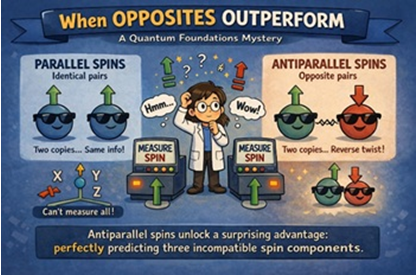
Fig: Simultaneous measurement of spin properties along three mutually orthogonal space directions becomes possible on antiparallel qubit-pair.
This result touches the very heart of quantum theory. In classical physics, measuring multiple properties is only limited by practical constraints. In contrast, quantum systems impose intrinsic limits—famously highlighted by Heisenberg uncertainty principle and Bohr’s complementarity principle. Yet here, by cleverly choosing how states are prepared, one can circumvent some of these limitations in a surprising way.
The work also connects to a famous quantum puzzle known as the Mean King’s problem, introduced by Yakir Aharonov and collaborators. Beyond foundational insights, the implications are practical. The enhanced compatibility offered by antiparallel configurations promises efficient characterization of unknown quantum devices a crucial step in building reliable quantum technologies. It also influences quantum cryptographic protocols, where extracting maximal information from limited quantum resources is essential.
At a deeper level, the study highlights a recurring theme in quantum physics: more symmetry does not always mean more power. Sometimes, introducing contrast—like flipping one spin against another—unlocks capabilities that identical systems cannot provide. In the quantum world, opposites don’t just attract—they sometime can reveal more.
Link: Physical Review Letters 136, 110402 (2026) - https://doi.org/10.1103/tqrb-4m9p
For more details, Contact: manik[dot]banik[at]bose[dot]res[dot]in